The group has also invented LUMOS (LUminescence-related Measurement Of Specific Detection), a proprietary, enzymatic reaction-based method to detect and degrade pesticides in a single-pot system. It addresses the serious environmental and health risks from the overuse of toxic organophosphate pesticides (OPs) whose toxic residues can contaminate produce, soil, ground water and water reservoirs. These have been linked to cancer, Alzheimer's, and diabetes, and pose risks to farmers, consumers and ecosystems.

LUMOS is a pesticide detection kit designed to enhance food safety and environmental sustainability through quick and reliable detection of pesticide residues in food, water, soil and human tissue. It empowers communities, supports sustainable agriculture, and helps ensure compliance with global safety standards.
In collaboration with KAI (K-Agro-Innovate Institute) under the Kasikornthai Foundation and the Nan Sandbox Project, LUMOS has been used to screen agricultural produce brought by farmers for sale, verifying that turmeric and other medicinal plants are free from chemical contaminants prior to procurement.
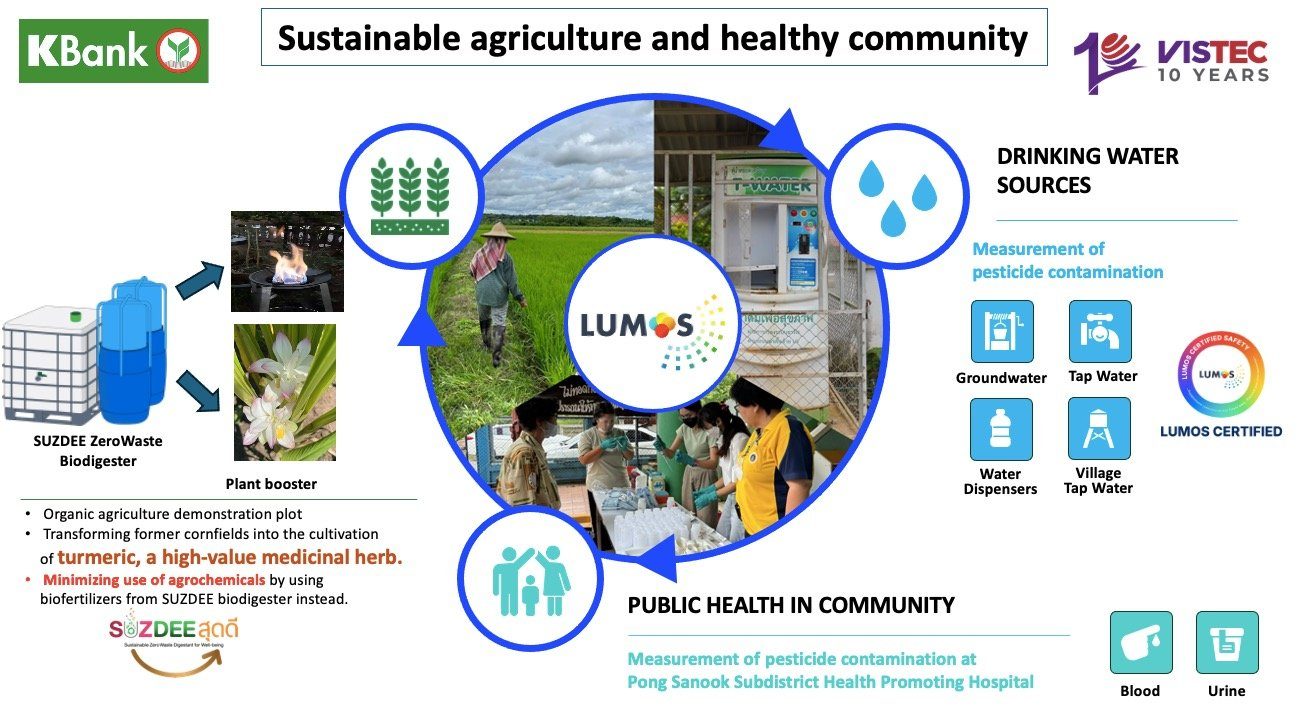
The pesticide detection technology has been scaled and implemented through the startup Detectra.
Key publication
Watthaisong P, et al., Chaiyen P. Luciferin Synthesis and Pesticide Detection by Luminescence Enzymatic Cascades. Angew Chem Int Ed 2022;61(16):e202116908. doi